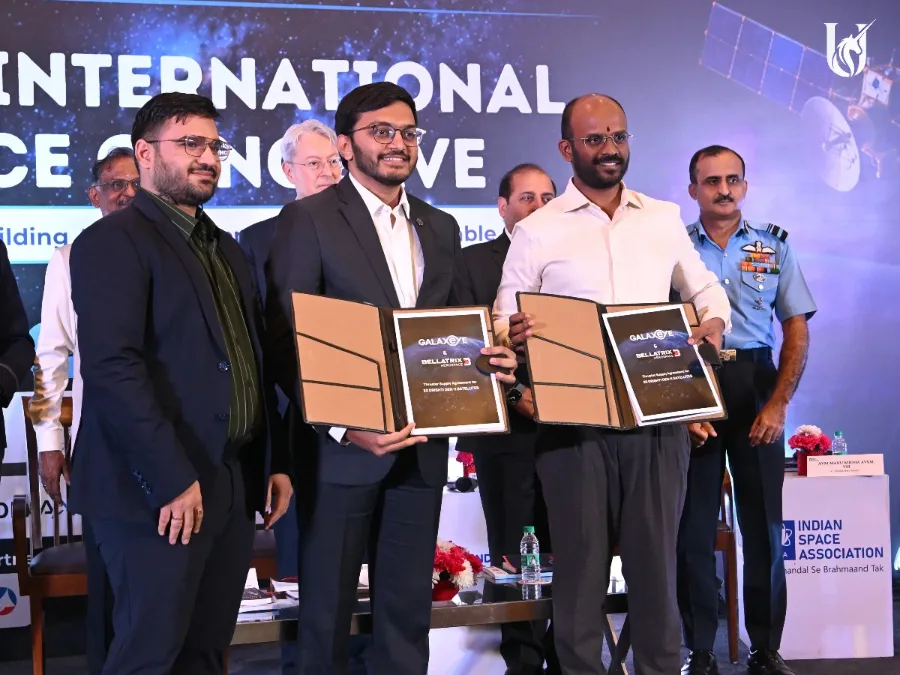
Bengaluru-based space-tech startup GalaxEye has awarded fellow Indian company Bellatrix Aerospace a multi-year contract to supply indigenous propulsion systems for its next 30 satellites, marking a significant step towards building a domestic private-sector space supply chain.
Announced on November 24, 2026, at the fifth India International Space Conclave in New Delhi, the agreement covers Bellatrix's Arka Hall-effect electric propulsion systems for GalaxEye's upcoming Drishti Gen-II OptoSAR satellite constellation.
The companies have not disclosed the contract value. GalaxEye describes the agreement as the largest business-to-business order between Indian private space companies by satellite count since the sector opened to private players in 2020.
GalaxEye was founded in 2021 by five IIT Madras alumni: Suyash Singh, Denil Chawda, Pranit Mehta, Kishan Thakkar and Rakshit Bhatt. Suyash Singh is the company's CEO, while Pranit Mehta is its co-founder and VP of Sales Operations.
Bellatrix Aerospace was founded in 2015 by Rohan M. Ganapathy and Yashas Karanam. Ganapathy serves as CEO and CTO, while Karanam is the company's co-founder and COO.
GalaxEye is developing an Earth-observation constellation combining electro-optical (EO) imaging and synthetic aperture radar (SAR) on the same satellite.
While optical sensors capture detailed images in suitable lighting and weather conditions, SAR uses radar signals to observe the Earth's surface through cloud cover and darkness. Combining both technologies allows GalaxEye to deliver more consistent Earth-observation data.
Bellatrix's Arka Hall-effect thrusters will perform several critical functions: moving satellites from their initial deployment orbits into assigned positions, maintaining spacing across the constellation, avoiding space debris and supporting controlled deorbiting at the end of their operational lives.
According to GalaxEye co-founder Pranit Mehta, deliveries will begin with propulsion systems for the first two satellites before scaling to the full 30-satellite programme. Bellatrix will serve as the programme's primary propulsion supplier.
The contract gives Bellatrix an opportunity to supply its propulsion technology across a multi-satellite commercial programme.
Its Arka product range includes Hall-effect thrusters designed for different power and thrust requirements. The company has also demonstrated its propulsion capabilities in space through ISRO's PSLV-C58 POEM-3 mission in January 2024. Its Rudra green-propellant system was subsequently tested aboard POEM-4 in January 2025.
GalaxEye aims to deploy its 30-satellite OptoSAR constellation by 2030. The company is also exploring partnerships with Indian suppliers for other critical components, including power, control and communication systems.
In September 2026, the Technology Development Board under the Department of Science and Technology signed an agreement to provide Rs 63.84 crore in financial support to GalaxEye under the Research, Development and Innovation Fund. The broader project has an approved cost of Rs 247.69 crore and aims to develop high-resolution multisensor satellite technology.
For India's space industry, the significance of this contract goes beyond the number of satellites. It demonstrates how domestic space companies can become suppliers to one another, creating opportunities for specialised manufacturers to move from technology demonstrations to larger commercial programmes.
For GalaxEye, execution will depend on integrating the propulsion systems reliably across its constellation. For Bellatrix, successful phased deliveries could strengthen its position as an Indian supplier of flight-ready satellite propulsion technology.