Introduction
Great businesses often begin with ordinary problems that most people choose to ignore. For Mukul Chhabra, the inspiration came from a childhood experience that left a lasting impression. What started as the theft of his bicycle eventually became the foundation for ScrapUncle, one of India's fastest-growing organized scrap collection and recycling startups.
Armed with curiosity, determination, and a desire to bring transparency to one of India's most unorganized industries, Mukul transformed the traditional kabadiwala model into a technology-enabled platform that has recycled over 20 million kilograms of waste, completed more than 300,000 household pickups, and raised over Rs 25 crore in funding.
His story is a powerful reminder that entrepreneurship is about identifying everyday problems and building scalable solutions that create real impact.
Early Life: A Childhood Memory That Sparked an Idea
Mukul Chhabra grew up in Sonipat, Haryana, in a family that had occasional interactions with the scrap trade through his maternal uncle, who worked as a scrap dealer.
As a child, Mukul experienced an incident that would stay with him for years. His brand-new bicycle was stolen from his home. When his family eventually discovered who had taken it, the thief turned out to be a local kabadiwala.
The incident deeply affected his family.
From that day onward, his parents refused to let scrap dealers enter their house because they no longer trusted them.
While most children would eventually forget such an experience, Mukul carried that memory with him. Years later, he would realize that the problem wasn't individual scrap dealers—it was the lack of trust, accountability, and organization in the entire industry.
Looking Beyond the Surface
While pursuing his BTech at IIIT-Delhi, Mukul began studying India's recycling ecosystem.
The more he observed, the more broken the system appeared.
He noticed several major problems:
- Kabadiwalas had no fixed locations.
- Customers never knew where to find them.
- Every dealer quoted different prices.
- Endless bargaining became unavoidable.
- Manual weighing often led to cheating.
- There was little transparency.
- Apartment residents struggled to access pickup services.
- Safety concerns discouraged families from inviting unknown collectors into their homes.
It wasn't just inconvenient.
It was an industry desperately waiting for innovation.
Research Before Building
Unlike many founders who jump directly into launching a startup, Mukul decided to spend months understanding the industry from the ground up.
During college vacations, he visited dozens of scrap dealers across Delhi.
He spent entire days observing how they worked.
He spoke with them about:
- Daily routines
- Income challenges
- Customer relationships
- Collection methods
- Pricing issues
- Operational struggles
He also distributed pamphlets in residential areas to understand whether households wanted a more reliable way to sell scrap.
The response surprised him.
People weren't just interested, they were actively looking for a trustworthy alternative.
That validation convinced him he had discovered a genuine market opportunity.
Learning From Failure
ScrapUncle wasn't Mukul's first startup.
During college, he had launched another venture with friends and even secured funding.
However, after nearly eighteen months, his co-founders decided to focus on academics, forcing the startup to shut down.
Many first-time entrepreneurs give up after their first failure.
Mukul didn't.
Instead, he treated the experience as preparation for something bigger.
He had gained valuable lessons about fundraising, teamwork, execution, and resilience.
Those lessons would become the foundation for his next venture.
The Birth of ScrapUncle
In 2019, while still completing his engineering degree, Mukul launched ScrapUncle.
The idea was beautifully simple.
Instead of searching for unreliable scrap dealers, customers could simply:
- Open the ScrapUncle app or website.
- View transparent, real-time scrap prices.
- Schedule a pickup at their preferred time.
- Have a verified executive arrive at their doorstep.
- Get materials weighed using a certified digital scale.
- Receive instant payment immediately after collection.
The platform solved every major pain point that existed in the traditional scrap industry.
Customers no longer had to bargain.
There was no manipulation in weighing.
Pickup became predictable.
Every collection agent was verified.
Trust finally entered an industry where it had been missing for decades.
Building a Startup With Limited Resources
Launching a startup while still being a college student wasn't easy.
Mukul constantly struggled with limited finances.
Managing operations, hiring people, and growing the business required far more capital than he had.
Despite these constraints, he continued improving the platform, expanding customer acquisition, and refining the business model.
A breakthrough came in January 2022, when Columbia University awarded ScrapUncle a grant.
The funding provided much-needed operational support and helped the startup survive its early growth phase.
The Shark Tank India Breakthrough
One of the biggest turning points in Mukul's entrepreneurial journey came through Shark Tank India.
Ironically, he had almost missed the opportunity forever.
He had actually been shortlisted for Season 1, but the invitation email landed in his spam folder, causing him to miss the selection.
When Season 2 arrived, he wasn't going to let history repeat itself.
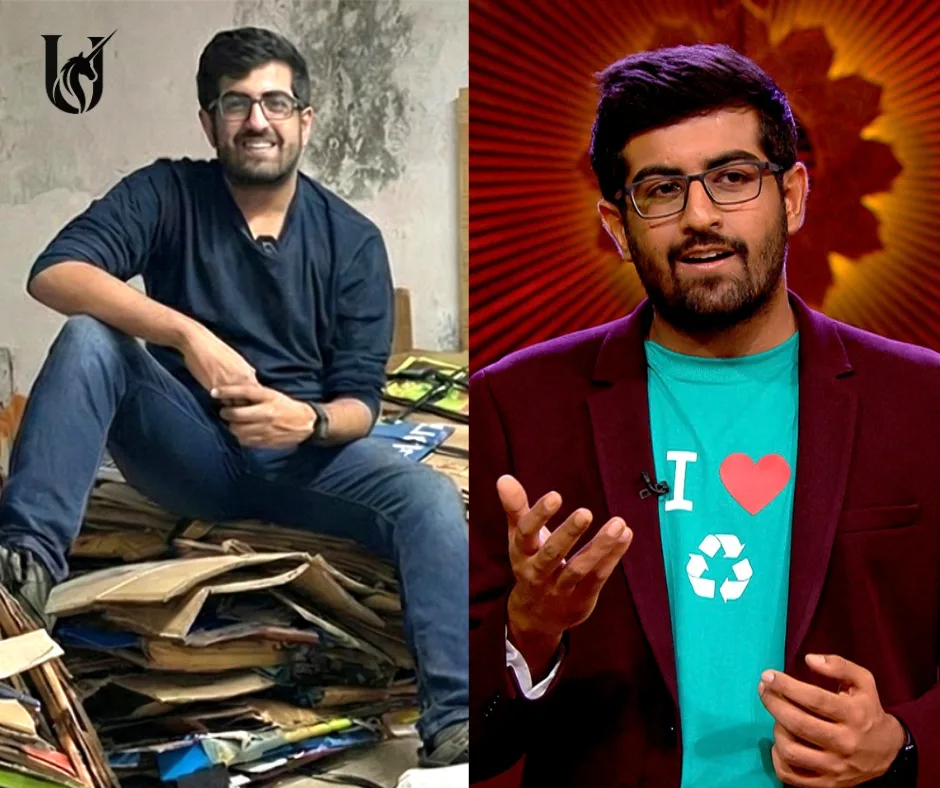
Standing before the Sharks, Mukul presented ScrapUncle's vision of digitizing India's scrap collection industry.
The pitch immediately caught everyone's attention.
A bidding war broke out between:
- Anupam Mittal
- Vineeta Singh
- Amit Jain
Within minutes, the startup's valuation doubled, from Rs 6 crore to Rs 12 crore.
Eventually, Mukul accepted Amit Jain's offer of Rs 60 lakh for 5% equity.
More valuable than the investment itself was the national visibility.
After the episode aired, ScrapUncle received nearly 30,000 new customer signups, dramatically accelerating its growth.
Scaling the Business
Following Shark Tank, investors began recognizing the startup's potential.
In 2023, ScrapUncle raised Rs 3.7 crore in a pre-seed funding round led by Bestvantage Investments, with participation from Amit Jain and strategic family office investors.
The fresh capital helped the company:
- Expand across Delhi-NCR.
- Improve warehouse operations.
- Strengthen logistics.
- Build partnerships with gated communities.
- Collaborate with corporate offices.
The company quickly evolved from a neighborhood service into a professionally managed recycling platform.
Major Funding Milestone
In January 2026, ScrapUncle announced its largest fundraising round yet.
The startup secured Rs 22 crore (approximately USD 2.4 million) in a Pre-Series A round co-led by:
- Orios Venture Partners
- Acumen Fund
Additional investors included:
- Upaya Social Ventures
- Venture Catalysts
- We Founder Circle
- Soonicorn Ventures
- Bharat Jaisinghani
The funding valued the company at approximately Rs 66 crore.
The investment was aimed at expanding into new cities, strengthening technology, improving warehouse infrastructure, and building India's most trusted organized recycling network.
Creating Environmental Impact
While ScrapUncle is a successful startup, its greatest achievement lies in its environmental contribution.
By mid-2026, the company had:
- Completed over 300,000 household pickups.
- Recycled more than 20 million kilograms (20,000 metric tons) of waste.
- Processed recyclable materials worth over Rs 45 crore.
- Recorded nearly 350,000 app downloads.
- Created sustainable livelihoods for around 200 informal waste workers, offering better income, safety, and working conditions.
Unlike traditional scrap businesses, all collected material is routed through company-operated warehouses, where it is carefully sorted before being supplied to authorized recyclers.
This ensures complete traceability and responsible waste management while maximizing recycling efficiency.
Recognition on the Global Stage
Mukul's innovative approach to solving an everyday problem earned him one of the highest recognitions for young entrepreneurs.
In 2025, he was featured in the Forbes 30 Under 30 Asia list in the Consumer & Enterprise Technology category.
The recognition placed him among Asia's most promising young innovators and highlighted how technology can modernize even the most traditional industries.
Leadership Philosophy
Mukul Chhabra's entrepreneurial journey reflects a simple yet powerful philosophy:
- Solve real problems, not imagined ones.
- Spend time understanding customers before building products.
- Validate ideas through field research.
- Build trust through transparency.
- Use technology to simplify everyday life.
- Stay resilient after failures.
- Focus on long-term impact rather than short-term profits.
His success demonstrates that meaningful innovation doesn't always require inventing something entirely new, it often comes from improving systems that millions of people already use every day.
Legacy
From a childhood memory of a stolen bicycle to building one of India's most trusted organized recycling platforms, Mukul Chhabra has shown that great entrepreneurs see opportunities where others see inconvenience.
Instead of accepting an outdated and fragmented scrap industry, he questioned why it couldn't be transparent, digital, and customer-friendly.
That simple question became ScrapUncle.
Today, his startup is not only making recycling easier for households but also creating employment, supporting India's circular economy, and reducing landfill waste through responsible recycling.
Mukul Chhabra's journey proves that entrepreneurship isn't always about creating the next revolutionary technology. Sometimes, it's about bringing trust, transparency, and innovation to industries that the world has overlooked for decades.