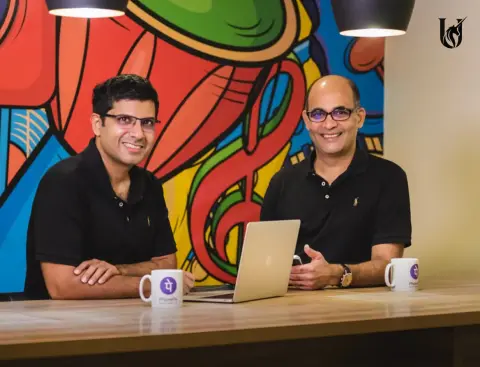

It Started With a Baby, Not a Business Plan
In 2016, Varun and Ghazal Alagh were not looking for a billion-dollar opportunity. They were simply looking for something every new parent wants: safe products for their child. When they struggled to find baby-care products they felt comfortable using in India, they began looking deeper into ingredients, formulations and safety standards. What started as a deeply personal parenting problem soon revealed a much larger gap in the market.
That realisation became the starting point of Mamaearth, a brand built around a simple promise: parents shouldn't have to compromise when choosing products for their children.
From Personal Frustration to a Company With a Purpose
Varun brought years of FMCG experience from companies including Hindustan Unilever, Diageo and Coca-Cola, while Ghazal came with a mix of technology, training, creativity and design experience. Together, they combined consumer insight with brand-building expertise.
In September 2016, they incorporated Honasa Consumer, and Mamaearth was launched later that year. The ambition was bigger than selling baby products: build a consumer brand that understood modern Indian parents and could eventually solve everyday personal-care problems for the entire family.
Six Products Were Enough to Begin the Journey
Mamaearth didn't enter the market with hundreds of products or a massive physical distribution network. It started small, focused on baby care, and used digital channels to reach parents directly.
The founders understood something important: before building a large customer base, they needed to build trust. Mamaearth therefore leaned heavily into conversations with digitally active mothers, using their feedback to shape products and the innovation roadmap.
The result was a brand that felt less like a traditional FMCG company and more like a conversation between parents.
The Real Growth Engine Was Listening to Customers
While traditional beauty brands were built around mass advertising and large retail networks, Mamaearth found an early advantage online. Social media, influencers, content and word-of-mouth allowed the company to speak directly to consumers.
Instead of asking, “What can we sell?”, the brand increasingly asked, “What problem are consumers trying to solve?”
That mindset helped Mamaearth move beyond baby care into skincare, haircare and personal care. The company eventually turned consumer insights into a much larger product pipeline, and that became one of the foundations of Honasa's broader house-of-brands strategy.
The First Challenge: Growth Wasn’t as Easy as It Looked
Every fast-growing startup eventually discovers that getting attention and building a sustainable business are two very different things.
Mamaearth's early growth also came with its share of challenges. The company had to understand exactly who its most valuable customers were, how to communicate with them and where marketing money generated the strongest returns.
The answer wasn't simply to spend more. It was to learn faster.
That ability to experiment, listen and change direction became an important part of the company's journey from a promising D2C brand into a much larger consumer business.
Mamaearth Stopped Being Just a Baby Brand
This was one of the biggest turning points.
Once Mamaearth established credibility among parents, the company realised the underlying consumer need wasn't limited to babies. Parents also wanted better skincare, haircare and personal-care products for themselves.
So the brand expanded.
Baby care became skincare.
Skincare became haircare.
Haircare became a broader personal-care ecosystem.
Mamaearth's story therefore shifted from “safe products for babies” to “purpose-driven personal care for modern Indian consumers.” Honasa today describes its DNA around consumer-first thinking, R&D, technology and sustainability.
From One Brand to a House of Brands
The bigger ambition was never going to be limited to Mamaearth.
Under Honasa Consumer, the founders built a portfolio that includes brands such as The Derma Co, Aqualogica and BBlunt, while also expanding through acquisitions including Dr. Sheth's.
This transformed Honasa from a single D2C success story into a house-of-brands platform targeting different consumer needs and price points.
It was a crucial strategic shift: instead of expecting one brand to serve everyone, Honasa could build or acquire brands specifically for different categories and audiences.
The D2C Revolution Became Mamaearth’s Playground
Mamaearth benefited enormously from India's e-commerce boom.
Its digital-first model allowed the company to test products quickly, collect consumer feedback and reach customers without initially depending entirely on traditional retail.
But the company eventually moved beyond the D2C playbook.
Online marketplaces, its own digital channels and physical retail became increasingly important as the brand entered the mainstream. The strategy evolved from “build online” to “be available wherever the consumer shops.”
That transition was essential because building a national FMCG company requires more than social-media visibility, it requires distribution, repeat purchases and operational scale.
The Rs 1 Billion Unicorn Moment
By January 2022, Honasa Consumer had reached a private valuation of roughly $1.2 billion, turning Mamaearth's parent company into a unicorn.
For a company that had started with a parenting problem only a few years earlier, the milestone was extraordinary.
But the bigger story wasn't the valuation itself. It was what the valuation represented: investors were beginning to see that India's D2C brands could evolve into large, enduring consumer companies rather than remain niche internet businesses.
Mamaearth had effectively helped prove that thesis.
From Startup to Stock Market
The next chapter was even bigger.
In 2023, Honasa Consumer went public. Its IPO priced the company at an equity valuation of roughly Rs 10,425 crore at the upper end of the price band.
The listing also changed the nature of the story.
Mamaearth was no longer simply a fast-growing startup backed by venture capital. Its parent company was now operating under the scrutiny of public-market investors, quarterly results and shareholder expectations.
The challenge had changed, from proving that consumers wanted the brand to proving that the business could create sustainable value at scale.
The Toughest Lesson: Growth Must Eventually Become Profitable
Public markets can be unforgiving.
Honasa had to navigate the realities of rising competition, changing consumer behaviour, brand investments and profitability expectations. Some experiments and businesses did not work as planned, forcing the company to make difficult strategic decisions.
But the important part of the story is that the company kept adapting.
By FY26, Honasa had moved into a significantly stronger profitability phase, and in Q1 FY27 it reported Rs 785 crore in revenue and Rs 90 crore in net profit, with profit rising 118% year-on-year.
That shift, from chasing growth to balancing growth + profitability, is arguably one of the most important chapters of the Mamaearth story.
The Brand Became Bigger Than Mamaearth
Today, the real story is no longer only about Mamaearth.
It is about Honasa Consumer building a portfolio of digital-first beauty and personal-care brands.
The company has moved from one parenting-led idea to multiple categories, multiple brands and a much larger consumer ecosystem. Its stated focus combines consumer understanding, product innovation, technology and sustainability.
Mamaearth was the door. Honasa became the house.
The Numbers Tell How Far the Journey Has Come
From a small launch in 2016, Honasa has grown into a publicly listed consumer company with a multi-brand portfolio.
As of late August 2026, Honasa Consumer's market capitalisation was around Rs 15,300 - Rs 15,800 crore, depending on the trading date/source. That is the market value of the listed company, not Ghazal or Varun Alagh's personal net worth.
The company also reported Rs 25.53 billion in trailing revenue in August 2026, while its market capitalisation had risen substantially over the preceding year.
From a problem in a young family's home to a listed company worth more than Rs 15,000 crore—that is the scale of the transformation.
Ghazal Alagh: From Mother Searching for Answers to Brand Builder
Ghazal's role in the story is particularly interesting because her entrepreneurial journey began with a very human trigger: the desire to make early parenting safer and less stressful.
Her background was far removed from traditional FMCG manufacturing. She had studied Information Technology and later pursued modern art and design before becoming an entrepreneur.
That unusual combination, technology, creativity and consumer empathy, became valuable when building a brand where product, communication and experience had to work together.
Her journey later expanded into investing, mentoring and judging startups, giving her a front-row seat to India's rapidly evolving entrepreneurial ecosystem.
Varun Alagh: Turning Consumer Insight Into a Scalable Business
If Ghazal brought deep consumer empathy and innovation into the founding story, Varun brought the discipline of traditional FMCG brand building.
His experience at HUL, Diageo and Coca-Cola gave him exposure to some of the world's strongest consumer brands before he entered entrepreneurship.
Together, the couple combined two worlds that rarely come together so neatly: the speed of a startup and the discipline of FMCG.
That combination became one of Honasa's biggest competitive advantages.
Sustainability Became Part of the Brand Story
Mamaearth also attempted to connect its consumer proposition with environmental responsibility.
Honasa says Mamaearth is Plastic Positive, meaning it recycles more plastic than it uses, and the brand is also cruelty-free certified by PETA.
The lesson here is subtle: modern consumer brands aren't judged only by what they sell. Increasingly, consumers want to know what a company stands for, how it operates and what impact it leaves behind.
What Made Mamaearth Different?
Mamaearth's biggest innovation wasn't necessarily a single product.
It was the decision to build around trust, consumer conversations and speed of learning.
The founders took a personal problem, validated that thousands of other parents faced it, built a product around that insight, created a community around the problem and then expanded into adjacent needs.
That is a powerful startup formula:
Personal problem > Consumer insight > Product > Trust > Community > Brand > Portfolio > Scale.
The Biggest Challenge Is Now Different
Building a startup is one challenge. Building a durable consumer company is another.
Today, Honasa operates in an intensely competitive beauty and personal-care market filled with established FMCG giants, digital-native brands and new-age challengers.
The question is no longer whether Mamaearth can attract attention.
The bigger question is whether Honasa can continue creating profitable, differentiated brands while keeping consumers loyal in a market where switching costs are extremely low.
That will ultimately determine whether its next chapter becomes bigger than its first.
The Mamaearth Formula: What Entrepreneurs Can Learn
Solve a problem you understand deeply. The story began with something the founders personally experienced.
Listen before you scale. Consumer conversations helped shape Mamaearth's product journey.
Build trust before chasing transactions. In personal care, credibility can become a powerful competitive moat.
Don't stay trapped inside your first category. Mamaearth started with babies but expanded because the underlying consumer need was much bigger.
Build the company, not just the brand. Honasa's evolution into a house of brands shows the importance of building capabilities beyond a single hit product.
And finally, remember that growth is only half the story. The real test comes when a startup has to turn scale into sustainable profits.
From a Mother’s Concern to a Rs 15,000+ Crore Consumer Story
The most fascinating part of Mamaearth's journey is that it didn't begin with a giant market forecast.
It began with a parent asking a very ordinary question:
“Is there something safer for my child?”
That question led Varun and Ghazal Alagh to build Mamaearth. Mamaearth led them to Honasa. Honasa led them to a portfolio of consumer brands. And that portfolio eventually became a publicly listed company with a market value of more than Rs 15,000 crore.
The lesson is bigger than skincare.
Some of India's biggest businesses don't begin when entrepreneurs find an opportunity. They begin when someone refuses to accept a problem as normal.
And perhaps that is the real Mamaearth success story, not that two founders built a beauty brand, but that one family's search for a better answer became a business millions of consumers could believe in.