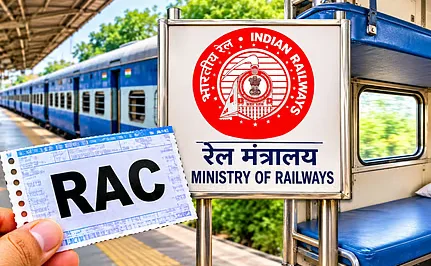
Indian Railways is examining whether to discontinue its decades-old Reservation Against Cancellation (RAC) system, under which two passengers can share a single berth while paying the full ticket fare. The review follows concerns over passenger convenience and the fairness of charging the full fare when travellers do not receive individual sleeping accommodation.
According to a multiple report published on November 13, railway authorities are considering the possibility of doing away with the RAC facility.
A railway official cited in the report said there was a view within the system that charging passengers the full fare without providing full sleeping space might not be appropriate.
However, Indian Railways has not announced any final decision to abolish RAC or issued a notification changing the existing rules.
Why Is Indian Railways Reviewing the RAC System?
RAC is a reservation category that allows passengers to board a train with reserved sitting accommodation even when a full berth is unavailable.
Under the existing arrangement, two RAC passengers may be allotted the same side-lower berth. The space is used as seating accommodation during the day and shared for sleeping when the train operates overnight.
If another passenger cancels a confirmed ticket or a berth becomes vacant, an RAC passenger may receive a full berth. If no vacancy arises, the passenger continues the journey with the allotted sitting accommodation.
The arrangement allows more passengers to travel on reserved tickets instead of remaining on the waiting list. However, it can become uncomfortable during long overnight journeys, particularly when unrelated passengers have to share the same sleeping space.
The system can also create practical difficulties for train ticket examiners when passengers request separate accommodation but no vacant berth is available.
Parliament's Public Accounts Committee Had Questioned Full RAC Fares
The debate over RAC fares is not new. The Public Accounts Committee (PAC) of Parliament addressed the issue in its 36th Report on Punctuality and Travel Time in Train Operations in Indian Railways.
Presented to the Lok Sabha on February 4, 2026, the report questioned the justification for collecting the full fare from passengers who remain in the RAC category after chart preparation without receiving a full berth.
The committee recommended that the Ministry of Railways develop a mechanism to provide a partial fare refund to passengers who pay the full amount but do not receive individual sleeping accommodation.
The recommendation places the focus on a basic passenger-rights question: should travellers pay the same fare when the accommodation provided is different?
However, a PAC recommendation is not automatically a change in railway policy. The Ministry of Railways would need to decide whether and how to implement it.
What Happens to RAC Tickets Under Existing Rules?
Under the current reservation system:
-
RAC passengers are permitted to board the train with reserved sitting accommodation.
-
Vacant berths arising from cancellations can be allotted to RAC passengers.
-
Berths becoming vacant during the journey may also be reassigned, subject to availability.
-
If no full berth becomes available, the RAC passenger travels using the allotted seat.
RAC is different from a waitlisted ticket. It provides confirmed sitting accommodation, while a fully waitlisted e-ticket that remains unconfirmed after chart preparation is generally not valid for boarding.
The existing rules therefore provide travel access, but they do not guarantee an individual sleeping berth to every RAC passenger.
What Could Change for Train Passengers?
If Indian Railways decides to discontinue RAC, it would need to determine how passengers currently accommodated under the system will be handled when confirmed berths are unavailable.
An alternative could involve revising the fare structure or introducing partial refunds for passengers who remain in RAC status after chart preparation. This would address the concern raised by the parliamentary committee without necessarily eliminating the facility.
For now, passengers should continue to follow the existing reservation rules. Any change to RAC bookings, fares or refunds will depend on an official announcement from the Ministry of Railways.
The larger challenge for Indian Railways will be balancing passenger comfort, affordable access and the efficient utilisation of limited berths across its heavily used train network.