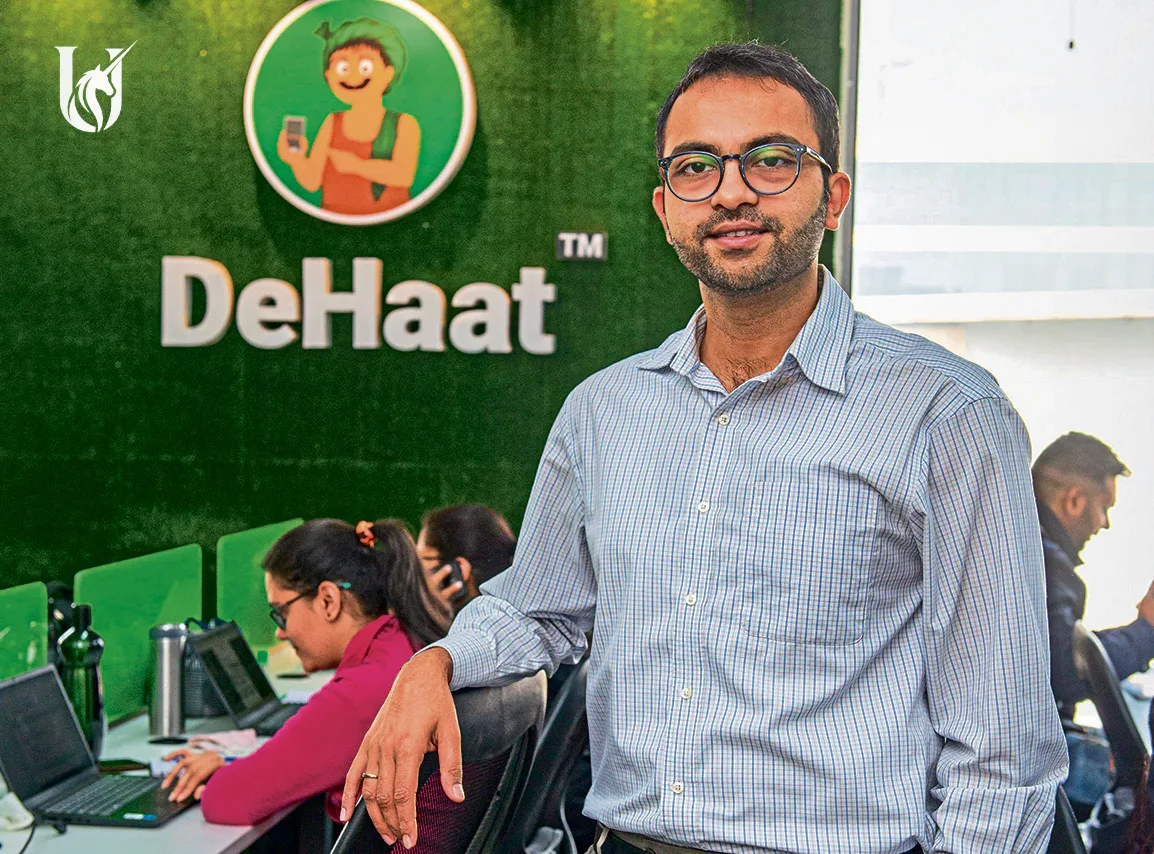
From Chhapra to IIT Delhi: The Journey Started With Curiosity
Shashank Kumar’s story began in Chhapra, Bihar, far away from the startup world he would eventually enter. His mother was a teacher, while his father worked with the Bihar National Electricity Board. After studying at Netarhat Residential School in Jharkhand, Shashank earned a degree in Textile Engineering from IIT Delhi in 2008. He also studied business administration as a minor, giving him a mix of technical and business thinking that would later become important in building DeHaat.
A Comfortable Career Wasn’t Enough for Shashank
After IIT, Shashank joined Beacon Advisory Services, where he spent around two and a half years working in management consulting. It was a respectable career with a predictable path, but Shashank wanted to work on a problem that felt closer to the ground. His interest gradually moved toward agriculture, where millions of farmers worked hard but still struggled with basic things such as good inputs, expert advice and reliable markets.
The Decision That Changed Everything
In 2011, Shashank decided to leave his job and work on agriculture with his friend Manish Kumar, an IIT Kharagpur alumnus. Together, they started a non-profit initiative focused on improving farming and rural livelihoods. A year later, that effort evolved into Green Agrivolution, the social enterprise that eventually became the foundation for DeHaat. It was a risky move for a young professional, but Shashank was beginning to see that agriculture needed more than short-term solutions.
His First Lesson Came From the Farmers Themselves
When Shashank started visiting villages, he quickly realised that having an IIT degree did not automatically earn him the farmers’ trust. Some farmers wondered what a 24-year-old young man could possibly teach them about farming. Instead of trying to prove himself from a distance, Shashank chose to listen. Those early conversations became one of the most important parts of DeHaat’s journey because they helped the team understand what farmers actually needed.
The Question Behind DeHaat
The problem was simple to describe but difficult to solve: Why do small farmers struggle when they are producing the food that feeds the country? Farmers often had limited access to quality seeds and fertilisers, timely crop advice and dependable buyers. The supply chain was fragmented, and middlemen often controlled important parts of the journey. Shashank saw an opportunity to connect these missing pieces through technology.
DeHaat Was Built Around the Whole Farmer Journey
DeHaat was designed to be more than an app where farmers could read agricultural information. The idea was to create one connected platform for farm inputs, crop advisory, financial services and market access. Farmers could get the products they needed, understand what to do with their crops and eventually find buyers for their produce. Technology became the bridge, but the real foundation remained the farmer.
Technology Alone Was Never the Answer
One of Shashank’s biggest realisations was that rural India could not be served through an app alone. Internet access, digital literacy and trust varied from village to village. DeHaat therefore built an offline network alongside its digital platform. Its local DeHaat Centres helped bring products, advice and market connections closer to farmers, combining technology with people who understood the local community.
Building Trust Took More Time Than Building the Product
The early years were not about chasing impressive numbers. They were about convincing farmers that this new model could genuinely help them. The team went into villages, spoke to farmers, tested ideas, and changed its approach based on what worked. In agriculture, one bad recommendation can affect an entire season’s income, so trust had to be earned slowly.
The Business Model Grew Around Real Farmer Needs
DeHaat eventually developed multiple revenue streams around the agricultural value chain. It earns through the sale of farm inputs, market-linkage services, and other products and services connected to farming. Instead of depending on one transaction, the company built a relationship with farmers across the entire crop cycle. That made the business model more closely connected to the farmer’s everyday needs.
From Bihar to a Much Bigger Agricultural Network
What started with a small team and a big problem gradually expanded beyond Bihar. DeHaat grew across India’s major agricultural regions, building a network designed to support farmers at the local level. According to company information, the platform now works with more than 1.8 million active farmers across 12 states and has built a physical network of 11,000+ DeHaat Centres.
The DeHaat Kendra Became a Local Growth Engine
The DeHaat Centre model became one of the company’s most important strengths. Rural micro-entrepreneurs operate these centres and act as a bridge between DeHaat and farmers. Instead of forcing every farmer to navigate a digital platform independently, the model brings technology into the village itself. It also creates local economic opportunities while expanding DeHaat’s reach.
AI Started Making Farming More Predictable
As DeHaat scaled, technology became increasingly sophisticated. The company uses data, satellite imagery and AI-driven models to provide crop-specific recommendations. Its advisory platform covers 30+ crops and supports multiple regional languages. The larger ambition is straightforward: give farmers useful information at the right time, before a small problem becomes a costly one.
The Company Started Connecting Farmers to Global Markets
DeHaat’s ambition eventually moved beyond helping farmers grow crops. It also began building stronger connections between Indian farms and international buyers. Through its export business, the company has expanded its reach to global markets, with fresh produce being shipped to more than 30 countries. This created another opportunity for farmers: instead of simply producing more, they could potentially access better and more organised markets.
Acquisitions Helped DeHaat Move Faster
Rather than building every capability from scratch, DeHaat also used acquisitions to strengthen its technology and supply-chain capabilities. Companies and platforms such as AgriCentral, FarmGuide, VezaMart and Freshtrop Fruits became part of this expansion. These acquisitions helped DeHaat add capabilities across crop intelligence, agricultural commerce and fresh-produce exports.
From Startup Experiment to Rs 3,000 Crore Business
The financial transformation has been striking. DeHaat crossed approximately Rs 3,000 crore in operating revenue in FY25, representing around 11% growth. Even more significant was the company’s reported Rs 369 crore net profit for the year, following earlier losses. The numbers show how the business has gradually moved from a mission-driven experiment toward a large and increasingly profitable agritech company.
Profitability Changed the Next Chapter
For years, the focus was primarily on building reach, technology and farmer adoption. The next challenge became proving that this scale could translate into sustainable economics. DeHaat’s improving margins, cost discipline and growing private-label business have helped push the company toward profitability. The company has also been reported to be operating at an annual revenue run rate of around Rs 4,000 crore.
Honest Farms Took DeHaat Closer to the Consumer
DeHaat also experimented with the other side of the agricultural chain through Honest Farms, its consumer-facing food business. The brand focused on pesticide-free food products and built a customer base across Indian cities. The business has since been separated into an independent entity, allowing it to pursue its own growth journey while DeHaat remains focused on its core agricultural platform.
The Numbers Tell Only Half the Story
Behind the Rs 3,000 crore revenue figure is a much larger network of people. More than 1.8 million active farmers, 11,000+ centres and 500+ Farmer Producer Organisations represent the scale of DeHaat’s grassroots model. The company is essentially trying to build an agricultural network where farmers can access everything from inputs and advice to markets without navigating the fragmented system alone.
Funding Gave the Vision Room to Scale
DeHaat’s growth attracted some of the biggest names in the global startup and impact-investing ecosystem. Funding allowed the company to invest in technology, expand its network, strengthen supply chains and acquire complementary businesses. But capital alone did not build DeHaat. The harder part was converting investment into trust across thousands of villages and different agricultural markets.
The Biggest Challenge Was Always the Ground Reality
Agriculture does not behave like a standard technology market. Crops, weather, soil, prices and farming practices change from region to region. A solution that works for a farmer growing wheat in one state may not work for someone growing grapes or bananas somewhere else. DeHaat had to build a model flexible enough to work with these differences rather than trying to force every farmer into the same system.
Shashank Chose Patience Over Quick Wins
The DeHaat journey shows why agritech businesses often take longer to build than typical consumer internet startups. You cannot simply acquire a farmer through an advertisement and expect long-term adoption. You have to prove that the product works, deliver on time and earn trust season after season. Shashank’s approach has largely been about building that relationship slowly and then scaling what works.
Recognition Followed the Impact
DeHaat’s work has attracted recognition from organisations including NITI Aayog, NASSCOM, Forbes, The Economic Times and the Bill & Melinda Gates Foundation. Such recognition reflects the wider importance of the model: using technology not simply to digitise agriculture, but to make the agricultural value chain more accessible to small and marginal farmers.
Shashank Kumar’s Rs 751 Crore Net Worth
Shashank Kumar’s entrepreneurial journey has also created substantial personal wealth. According to 360 ONE’s Wealth Creators List, his estimated net worth is around Rs 751 crore ($80 million), largely linked to his equity in DeHaat. The figure reflects the value attributed to his stake in the agritech business rather than a publicly disclosed cash fortune. It is another indication of how a venture that started with a small team working closely with farmers has grown into a large-scale agricultural technology company. Importantly, personal net-worth estimates can change with private-company valuations and ownership changes.
The Real Achievement Isn’t Just Rs 3,000 Crore
It would be easy to look at DeHaat’s revenue and call the story a financial success. But the more interesting part is what sits behind that number. A young IITian left a comfortable career, spent time listening to farmers who initially questioned his expertise, and slowly built a system connecting them to products, knowledge and markets. The business grew because the problem was real.
From a Village Problem to a National Platform
Shashank Kumar did not try to make farming fashionable. He tried to make it work better. DeHaat took a problem that had existed for generations and approached it with technology, local networks and a deep understanding of the farmer’s daily reality. That combination helped transform a small experiment into one of India’s most significant agritech platforms.
The Bigger Vision: Make Farming Less Uncertain
The next opportunity for DeHaat lies in making agriculture more predictable. AI, satellite data, crop intelligence, market forecasting and financial services can help farmers make decisions earlier and with better information. If DeHaat can successfully connect these pieces, its role could move from being a service provider to becoming a long-term digital partner for millions of Indian farmers.
What Shashank Kumar’s Journey Teaches Entrepreneurs
The first lesson is simple: start with a problem you genuinely understand. The second is that technology works best when it fits into people’s real lives. The third is that trust cannot be bought through marketing; it has to be earned through consistent results. And perhaps the biggest lesson from DeHaat is that some of India’s biggest businesses may not come from creating something completely new, but from fixing systems that millions of people have struggled with for years.
The Story of DeHaat Is Bigger Than a Startup
DeHaat began with a young entrepreneur asking why farmers were still struggling despite doing one of the most important jobs in the country. More than a decade later, that question has grown into a business serving 1.8 million+ farmers, operating 11,000+ centres and generating Rs 3,000 crore+ in annual revenue. For Shashank Kumar, the journey from IIT Delhi to agritech entrepreneur is not simply a story of leaving a high-paying job. It is the story of taking a problem from the fields and building a business around solving it.