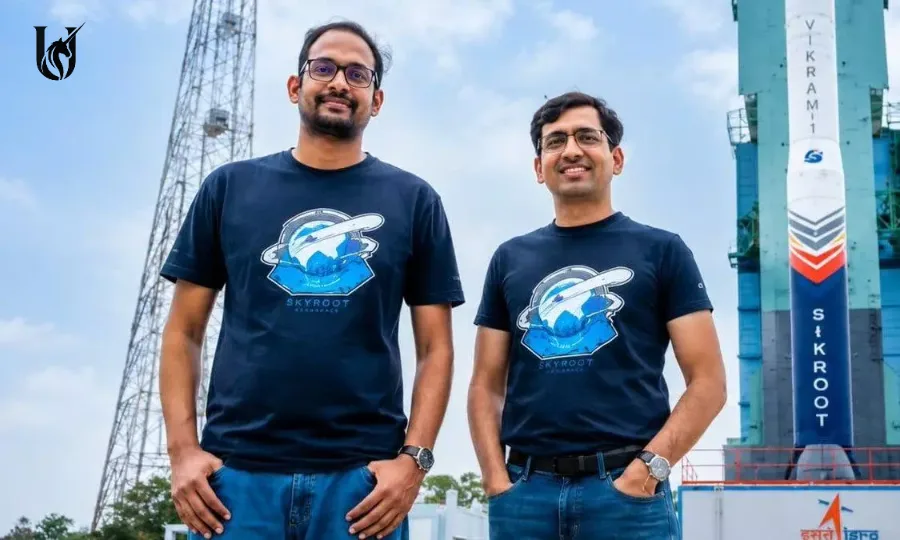
Hyderabad-based Skyroot Aerospace plans to begin full-fledged commercial rocket launches in the first quarter of 2027, with co-founder Naga Bharath Daka saying the company aims to reach a launch cadence of one mission a month by the end of next year.
The plan marks a shift from technology demonstration to commercial execution for the space-tech startup. Skyroot intends to start commercial missions from its third flight, following two initial demonstration launches of its Vikram-1 rocket.
The company successfully completed Vikram-1’s maiden orbital flight on July 18, 2026, becoming the first Indian private company to place a rocket into orbit from Indian soil. Its second launch is targeted for the end of 2026.
Vikram-1’s next flight to incorporate improvements
The second mission will use the same vehicle configuration, with refinements based on data collected during the maiden flight. Daka told The Unicorn Magazine that the first two flights were planned as demonstration missions, but the success of the maiden launch has allowed the company to focus on improving reliability.
One area being addressed is the stage separation mechanism, where modifications are being considered to reduce differences in separation rates.
Skyroot’s longer-term ambition is to increase launch frequency beyond one mission a month, potentially reaching two launches a month as the business scales. These remain targets, with execution and reliability central to achieving them.
International launch deals strengthen commercial pipeline
Skyroot is building an international customer base as it prepares for commercial operations. US-based Reflect Orbital has purchased two dedicated launches, while Indian space-tech company HEX20 has signed an agreement for three Vikram-series missions beginning in the fourth quarter of 2027.
The Reflect Orbital contract includes a first mission on Vikram-1 and a second on the Vikram-1U, a vehicle that is still under development. HEX20’s missions will support its Earth-observation constellation and payload demonstrations, with scope for rideshare opportunities.
The company is also seeing interest from customers in the US, Europe and Asia-Pacific.
A $1-2 billion market, but execution remains the test
Skyroot estimates the addressable market for small dedicated launch vehicles at $1–2 billion. It aims to become one of the four or five leading players in this segment.
Daka has identified execution, rather than market demand, as the immediate challenge. For early customers, reliability and a proven flight record are likely to matter more than price. Competitive pricing is expected to become a stronger lever as Skyroot builds its launch history.
The company had raised around $150-160 million by the time of its maiden orbital launch, with nearly half of that amount still unspent, Daka told. Skyroot expects launch revenues to gather pace in FY27, but has not disclosed revenue projections.
The next phase will therefore be measured not just by successful launches, but by how consistently Skyroot can deliver missions, convert agreements into completed flights and build a dependable commercial schedule.