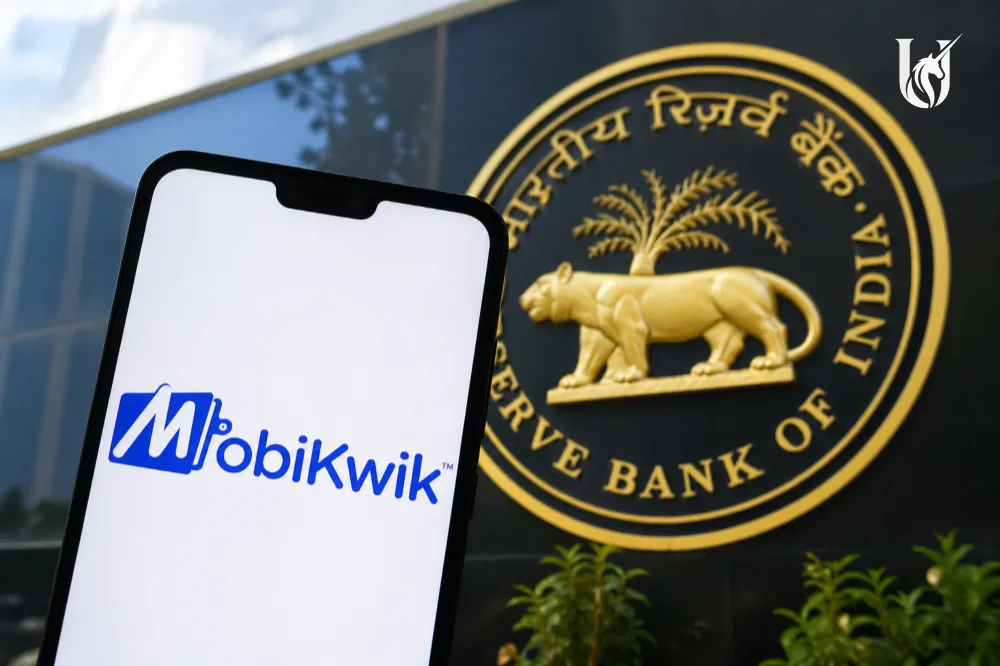
Fintech company MobiKwik has received the Reserve Bank of India's (RBI) Certificate of Registration for its wholly owned subsidiary, MobiKwik Financial Services Pvt Ltd (MFSPL), allowing it to operate as a non-banking financial company (NBFC). The company plans to disburse loans worth Rs 5,000 Cr over the next three to four years as it expands its presence in India's digital lending market.
The registration was issued on November 5, 2026, and received by the company on November 6, following the RBI's in-principle approval in April. MFSPL is expected to commence operations within the next three to six months, partnering with banks and other NBFCs through an asset-light co-lending model.
Founded in 2009 by Bipin Preet Singh and Upasana Taku, MobiKwik has built its business around digital payments, consumer credit and financial services. The NBFC licence marks a move towards taking a more direct role in the lending value chain, complementing its existing lending service provider (LSP) and distribution operations.
MobiKwik plans asset-light co-lending model
MFSPL plans to offer both secured and unsecured credit products to consumers and micro, small and medium enterprises (MSMEs).
Rather than financing its entire loan book independently, the subsidiary intends to work with established lending institutions. Under the proposed 10:90 co-lending structure discussed by the management, MobiKwik would contribute 10% of the loan amount, while its lending partner would provide the remaining 90%.
During the company's Q2 FY27 earnings discussion, Co-founder and CFO Upasana Taku indicated that MobiKwik could initially route around 10% of its digital lending disbursals through the NBFC.
For illustration, if total digital lending disbursals reach ₹6,000 crore next year, MobiKwik could aim to route approximately ₹600 crore through MFSPL. At a 10:90 funding split, this would require around ₹60 crore from the subsidiary, with the lending partner funding the balance.
The ₹6,000 crore figure is an illustrative scenario discussed by management, not a confirmed disbursal forecast. The ₹5,000 crore target, meanwhile, is the company's stated ambition for the NBFC over three to four years.
MobiKwik reports fourth consecutive profitable quarter
The regulatory approval comes as MobiKwik reports an improvement in its financial performance.
For Q2 FY27, the company reported consolidated net profit of Rs 11.8 crore, compared with a net loss of ₹28.6 crore in the year-ago quarter. This marked its fourth consecutive profitable quarter.
Revenue from operations increased 9% YoY to Rs 295.7 crore, against Rs 270.2 crore in Q2 FY26. EBITDA stood at Rs 22.7 crore, compared with a loss of ₹6.4 crore in the corresponding quarter last year.
Its lending business also recorded growth. Lending disbursal GMV increased 34% YoY to Rs 1,082.6 crore in Q2 FY27, from Rs 807.1 crore a year earlier.
MobiKwik said it had expanded its lending partner network to 11 from six a year earlier. Its current lending mix comprised 21% distribution-led disbursals and 79% under the first-loss default guarantee (FLDG) model.
A bigger role in India's digital credit market
The NBFC registration gives MobiKwik greater flexibility to develop credit products, originate loans and deepen relationships with lending partners.
For the company, the opportunity lies in combining its existing customer reach, technology infrastructure and underwriting capabilities with a regulated lending entity. The co-lending approach could also help it participate in loan economics without having to fund the entire portfolio itself.
However, the model will require disciplined underwriting, collections and risk management. A larger lending book does not automatically translate into higher profitability, particularly when credit costs and default risks are taken into account.
MobiKwik's next challenge will be to translate its regulatory approval and existing lender relationships into sustainable loan growth while keeping its balance-sheet exposure under control.
Disclaimer: This article is for information purposes only and is not investment advice. Investments in securities are subject to market risks. Please read the official offer documents before investing.