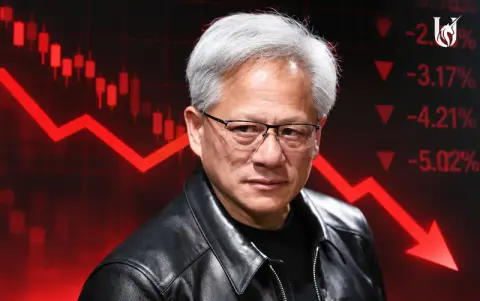
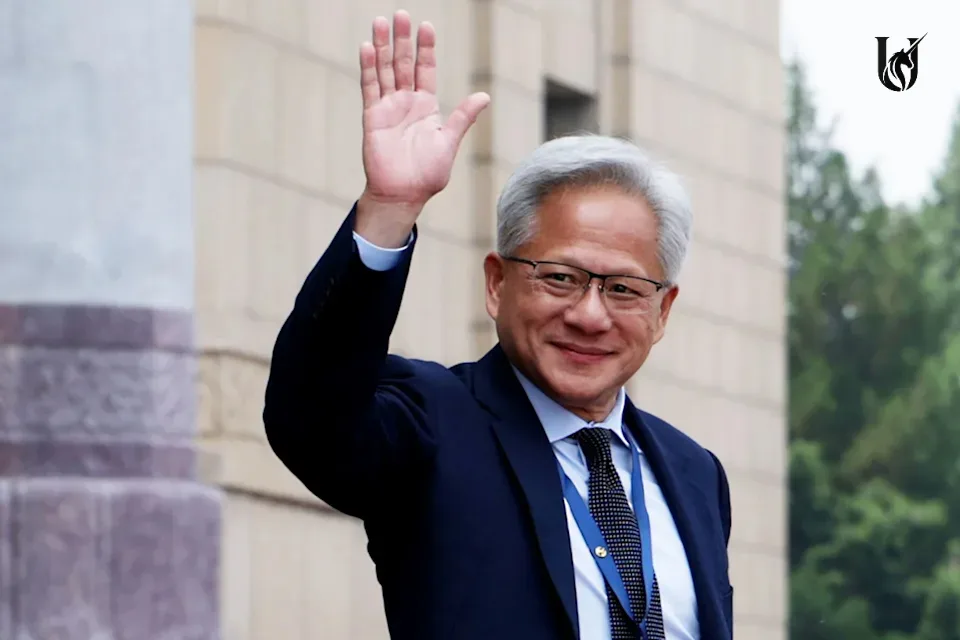
An online campaign demanding Jensen Huang's return as Nvidia CEO has crossed 1.32 lakh signatures, attracting support from Elon Musk and prominent Silicon Valley executives just days after the chipmaker's co-founder stepped down.
The petition, titled Stand with Jensen, had recorded 133,326 signatures on its website, according to figures reported by The Unicorn Magazine on November 15, 2026. The campaign is calling on Nvidia's board to reinstate Huang while an independent investigation examines the circumstances surrounding his departure.
The displayed count included 6,667 people identifying themselves as current Nvidia employees, 1,251 former employees, 72,265 shareholders and 53,143 other supporters. These affiliations are self-reported and have not been independently verified.
Elon Musk, Amjad Masad and Tim Sweeney Back the Campaign
Tesla and SpaceX CEO Elon Musk publicly supported the campaign on X. Other technology leaders associated with the petition include Replit CEO Amjad Masad and Epic Games CEO Tim Sweeney. Y Combinator CEO Garry Tan was also listed among the supporters, according to Multiple sources.
The open letter argues that a leadership change after 33 years should be supported by a transparent process and a fair hearing.
It asks Nvidia's board to bring Huang back while an independent investigation establishes the facts, unless directors can demonstrate that his departure is in the company's best interests.
The campaign is also seeking details about the investigation's scope and timeline, an opportunity for Huang to respond, and a public explanation of the board's decision.
The petition describes itself as an independent campaign and does not represent an official Nvidia initiative.
Why Did Jensen Huang Leave Nvidia?
Nvidia announced Huang's resignation on November 12, 2026. The company's regulatory filing shows that its board accepted his resignation on November 11, effective immediately.
Huang stepped down as president, CEO, and a member of the board. Colette Kress, Nvidia's chief financial officer since 2013, was appointed interim CEO, while the board began searching for a permanent successor. Former Synopsys CEO and long-time Nvidia director Harvey C. Jones was appointed chairman.
The leadership change followed reports concerning Huang's personal relationships and allegations involving a former executive at Singapore-based Megaspeed International. US authorities reportedly suspected the executive of having links to Chinese intelligence, an allegation that has not been established publicly. China has denied the espionage claims.
Nvidia's independent directors had already initiated an investigation on November 8 into reports that Huang may have been targeted by a foreign intelligence effort. On November 10, the board appointed law firm Wachtell, Lipton, Rosen & Katz, led by former acting US attorney Joon H. Kim, to conduct the inquiry.
Nvidia said it had no reason to believe that company secrets or US national security information had been compromised.
Employees and Investors Want the Board to Take Its Time
The campaign comes amid wider discussion about the company's succession process.
Technology publication WIRED reported that an internal Nvidia employee post urging the board to consider staff sentiment had attracted more than 1,600 comments, including calls for Huang's reinstatement.
Separately, Altimeter Capital founder Brad Gerstner and Atreides Management founder Gavin Baker urged the board not to rush its search for a permanent CEO and to keep the possibility of Huang's return open.
The petition and investor comments highlight the importance of leadership continuity at a company whose strategy has been closely associated with its co-founder.
Nvidia's Next Leadership Test
Huang co-founded Nvidia in 1993 with Chris Malachowsky and Curtis Priem. Under his leadership, the company evolved from a graphics-chip manufacturer into a central supplier of computing infrastructure for artificial intelligence.
His departure therefore has implications beyond a conventional CEO transition. Nvidia's product strategy, developer ecosystem, relationships with major technology companies and investments across the AI industry have all been shaped during his tenure.
The immediate challenge for the board is to maintain confidence among employees, shareholders, customers and technology partners while the investigation and succession process continue.
Nvidia is scheduled to announce its fiscal 3rd quarter 2027 financial results on November 17. The results and management commentary will provide an early opportunity to assess how the leadership transition is being handled.
The petition has amplified calls for transparency, but its signature count does not establish the views of Nvidia's entire workforce or shareholder base. Ultimately, the decision to reinstate Huang or appoint a permanent successor rests with the company's board.
Editorial notes
-
Signature count: 133,326 is a reported snapshot, not a permanent or independently audited total. Other publications reported different counts as the petition continued to gain signatures.
-
Employee and shareholder numbers: These categories are based on self-reported affiliations, not verified Nvidia employment or shareholding records.
-
Resignation versus removal: Nvidia's SEC filing records Huang's resignation, accepted by the board. The petition's demand to reinstate him should not be described as proof that the board formally removed him.
-
Investigation: The board's investigation began before Huang's resignation. Allegations involving foreign intelligence remain allegations, not established findings.
-
Founder names: Nvidia was founded by Jensen Huang, Chris Malachowsky and Curtis Priem in 1993.