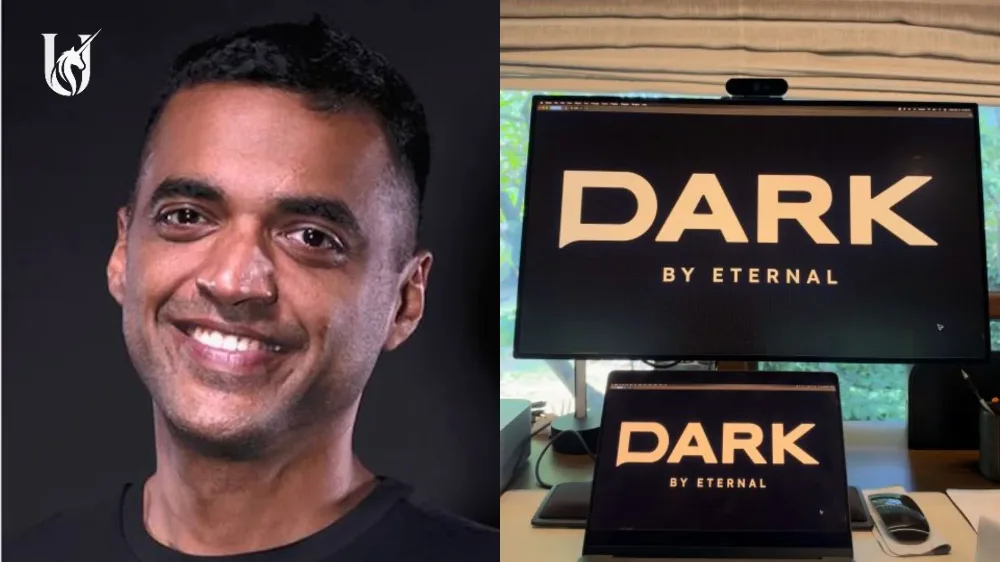
Eternal founder and vice chairman Deepinder Goyal has teased a new product called Dark.ai, describing it as coming soon from the house of Eternal. The announcement has sparked interest ahead of the company’s September-quarter results, although details about the product’s purpose, launch date and business model remain undisclosed.
Goyal shared the teaser on X on Wednesday, October 21, posting a photograph of two screens carrying the logo “Dark by Eternal”. He did not provide further details about what the product will do or whether it will operate as a standalone business.
Eternal, formerly known as Zomato, operates food delivery, quick-commerce platform Blinkit, B2B supplies business Hyperpure and going out platform District. A new technology initiative could broaden the company’s activities, but the teaser alone does not establish whether Dark.ai will be a consumer product, an enterprise offering or an internal technology platform.
Dark.ai Adds to Deepinder Goyal’s Technology Bets
Goyal has increasingly explored technology and health-related projects beyond Eternal’s core consumer businesses. One of the best-known is Temple, a wearable device being developed through his health tech company, Temple Private Limited.
Temple is designed to track cerebral blood flow using optical sensors positioned at the temple. Goyal has described the device as a tool for elite athletes and performance monitoring, with a proprietary “Entropy” score intended to reflect physiological strain.
In February 2026, Goyal said Temple had raised funding in a friends-and-family round at a post-money valuation of about $190 Mn. That figure was publicly reported but has not been independently verified.
Eternal Unveils Dark.ai, a Privacy-Focused AI Assistant From Deepinder Goyal
Eternal, the parent company of Zomato and Blinkit, is developing Dark.ai, a privacy-focused AI assistant designed to keep users’ conversations inaccessible to the company itself. Founder and vice chairman Deepinder Goyal revealed the initiative on October 21, 2026, expanding on an earlier teaser that described the product as “coming soon”.
According to Goyal’s shareholder letter, Dark.ai will use fine tuned, open-weight AI models hosted on Eternal’s own infrastructure. The company says end-to-end encryption will prevent it from reading users’ conversations, while an encrypted memory layer will allow context to carry across sessions under the user’s control. A global launch is planned before the end of 2026.
The product marks a move beyond Eternal’s core food delivery, quick-commerce and restaurant-supply businesses into AI software. It also reflects Goyal’s interest in higher-risk technology projects following his move from group CEO to vice chairman.
How Dark.ai Plans to Stand Out
Privacy is the central promise of Dark.ai. Goyal has argued that opting out of AI model training does not necessarily resolve every concern about how conversations may be retained, reviewed or accessed.
Dark.ai is intended to address those concerns through end-to-end encryption and user-controlled encrypted memory. Eternal says the service will run on fine-tuned open-weight models hosted on its infrastructure, rather than relying entirely on an external AI provider to handle conversations.
The company is targeting users for whom confidential information is particularly important, including founders, researchers, scientists, enterprises and government organisations. Eternal has reportedly been using the product internally for several months and plans to publish performance benchmarks.
However, the privacy claims will need to be assessed against technical documentation and independent security testing. Encryption, data retention, account recovery and the handling of prompts by AI models all matter when evaluating whether a service can deliver the level of confidentiality it promises.
Dark.ai Expands Eternal’s AI Ambitions
Dark.ai is not Eternal’s first AI product. The company previously developed Nugget, a no-code AI customer-support platform that began as an internal tool for Zomato, Blinkit and Hyperpure before being made available to businesses in 2025. Dark.ai represents a different focus: private, general-purpose AI conversations rather than customer-support automation.
Eternal has not disclosed the investment allocated to Dark.ai, its pricing, or the legal entity that will operate the service. The company also has yet to publish independent benchmarks for the product.
The announcement came alongside Eternal’s Q2 FY27 results. The company reported consolidated adjusted revenue of ₹24,621 crore, up 76% year-on-year, while consolidated adjusted EBITDA rose 197% to ₹666 crore.
For Eternal, the opportunity is to build an AI business alongside its established consumer platforms. For users, Dark.ai’s appeal will depend on whether its privacy architecture, answer quality and ease of use can compete with established AI assistants.
The launch will be worth watching, but the central test is straightforward: can Dark.ai prove its privacy promise without compromising the usefulness of its AI?